
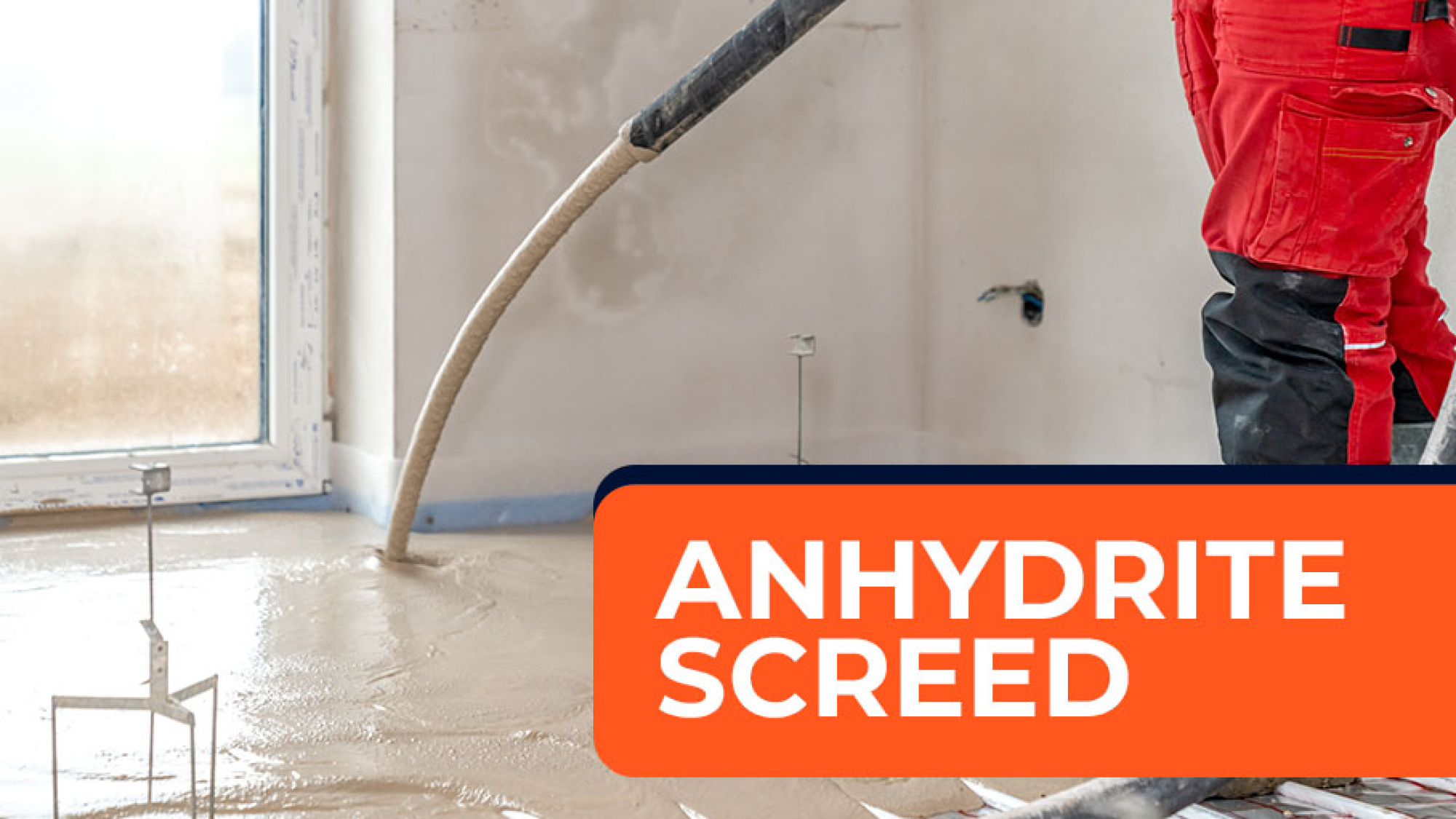
Let’s be honest for a second. Unless you work in construction or have a very specific (and slightly unusual) hobby, you probably don’t spend your Friday nights discussing floor screed. It’s the unsung hero of your home—the layer that sits between the rough concrete subfloor and those beautiful tiles or plush carpets you actually look at.
But if you are planning a renovation, a new build, or installing underfloor heating, ignoring your screed choice is a rookie mistake. Pick the wrong one, and you could be waiting months for floors to dry or, worse, end up with a cold, uneven surface.
Enter anhydrite screed (also known as calcium sulphate screed). It’s the modern, liquid solution that is rapidly sending traditional sand and cement mixes into retirement.
At PCS City Group, we’ve poured enough floors across Essex, London, and Kent to know that not all screeds are created equal. So, grab a coffee, and let’s dive into the world of calcium sulphate (trust us, it’s more interesting than it sounds).
What is anhydrite screed exactly?
Simply put, anhydrite screed is a liquid floor preparation solution. But to get a bit scientific, it’s a mix of sand, water, additives, and—the secret ingredient—a calcium sulphate binder (anhydrite).
Unlike traditional screeds that rely on cement to bind everything together, anhydrite uses this gypsum-based compound. This chemistry lesson matters because when you add water to the mix, the reaction creates gypsum, which doesn’t shrink anywhere near as much as cement does while drying.
Think of traditional sand and cement screed as the “old guard.” It’s reliable, sure, but it’s also labor-intensive, prone to cracking if not careful, and takes an eternity to dry. Anhydrite screed is the tech-savvy upgrade—it flows easily, levels itself out, and gets the job done with significantly less fuss.
The big benefits of choosing anhydrite over traditional screed
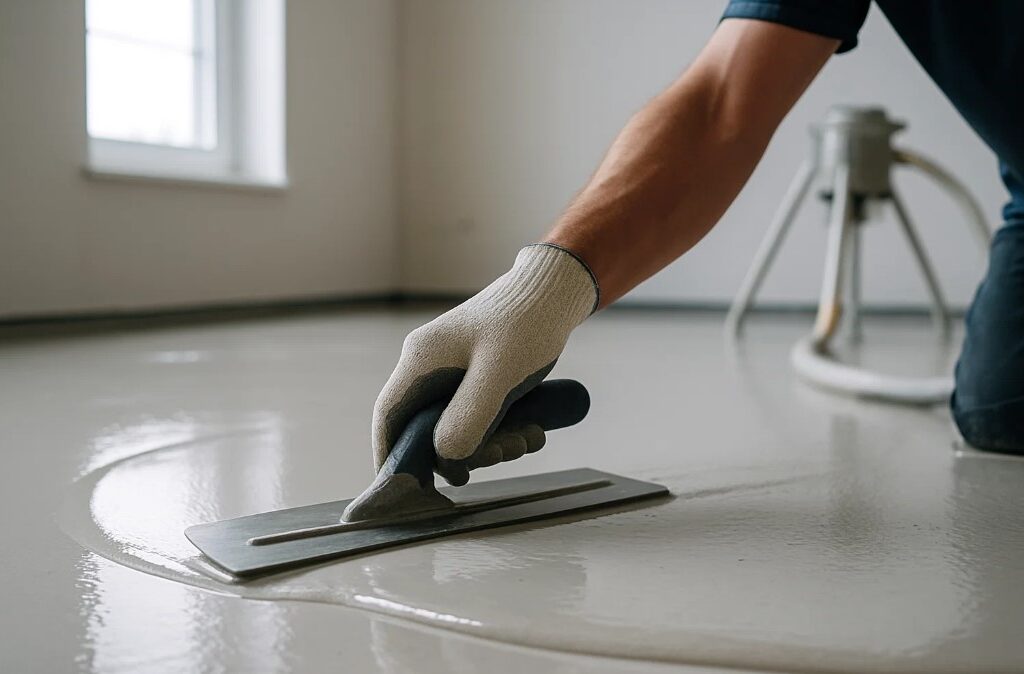
Why is everyone in the construction world making the switch? It’s not just because it looks satisfying when it’s poured (though it really does). Here is why anhydrite is generally the superior choice for modern floors.
1. It dries faster than cement screed and most other floor screeds
One of the biggest headaches in building projects is waiting for the floor to dry so you can put the final coverings down. Traditional cement screeds dry at a rate of about 1mm per day. If you have a standard 75mm depth, you could be waiting over two months before you can tile.
Anhydrite screed changes the game. Because it can be laid thinner (often just 35mm to 50mm), it dries significantly faster. While traditional floors might take 40 days or more to be ready, anhydrite can be walkable in 24-48 hours and ready for force-drying in as little as 7 days. If you are on a tight schedule, this is a lifesaver.
2. It’s superb for underfloor heating systems
If you are installing wet underfloor heating pipes, anhydrite screed is arguably your best friend.
Traditional screed often leaves air pockets around the heating pipes. Air is a terrible conductor of heat (think about how double glazing works). Those air pockets mean your boiler has to work harder to push heat through the floor and into your room.
Anhydrite flows as a liquid. It completely encases the heating pipes, eliminating air gaps. This creates superior thermal conductivity. Your room heats up faster, the heat is distributed more evenly, and your energy bills might just look a little friendlier.
3. Laser-flat finishes
Because it is pumped in as a liquid, anhydrite is self-compacting and self-levelling. Gravity does most of the hard work for us.
With traditional dry screed, the finish relies heavily on the skill of the person spreading it with a trowel. Even with the best tradespeople, human error happens. With anhydrite, you get a surface that is incredibly smooth and level—perfect for laying vinyl, large-format tiles, or wood flooring without worrying about bumps and dips.
4. No more heavy lifting
From an installation perspective, this stuff is a dream. We pump it directly from a truck into your building. There are no wheelbarrows damaging your doorframes and no dust clouds choking up the hallway. It’s cleaner, faster, and much more efficient.
When is anhydrite screed used?
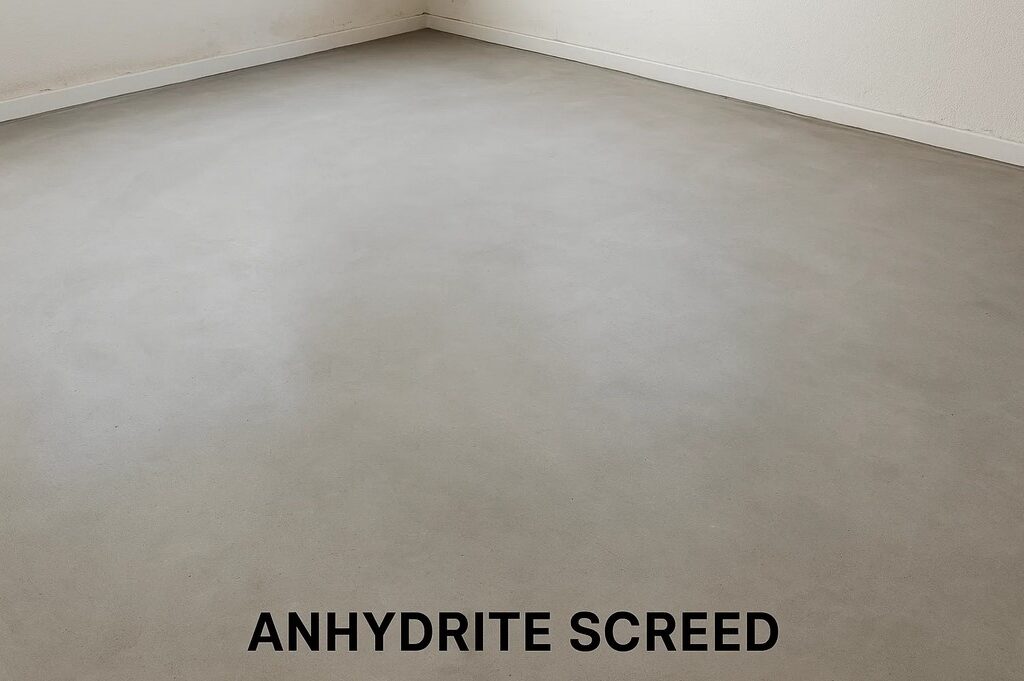
You will find anhydrite screed popping up in everything from cosy residential extensions to massive commercial developments.
It is the go-to choice for:
- New builds: Where speed and efficiency are key to keeping the project on track.
- Renovations: Especially where floor height is an issue. Because anhydrite is stronger than cement, it can be laid thinner, saving precious ceiling height.
- Eco-friendly projects: Many anhydrite binders are made from recycled industrial by-products, making it a greener choice than carbon-heavy cement.
However, the absolute “sweet spot” for this material is over underfloor heating systems. The efficiency gains are just too good to ignore.
How is it applied? (Don’t try this at home)
While we love a good DIY spirit, applying liquid screed is definitely a job for the pros. It requires specialised pumps and precise preparation.
Here is a snapshot of how the PCS City Group team handles it:
- Preparation is key: We ensure the subfloor is sealed tight. Because the screed is liquid, if there is a gap or a hole, the screed will find it and escape. We call this “tanking” the room.
- Setting the levels: We use laser levels and tripods to ensure the finished floor will be perfectly flat.
- The pour: The mix is pumped in through a hose. It flows quickly, covering large areas in a fraction of the time it takes to lay dry screed.
- Dappling: We use a dappling bar to gently ripple the surface. This releases any trapped air bubbles and ensures a smooth finish.
Maintenance and care
Anhydrite screed is tough, but it does have one quirk you need to know about: laitance.
As the screed dries, a fine layer of weak, powdery material (laitance) rises to the top. Before you stick any tiles or glue down, this skin needs to be sanded off. It’s a quick mechanical process, but it’s vital for ensuring your floor glue sticks properly.
Also, anhydrite doesn’t love getting wet once it’s set. While it’s fine in bathrooms if properly sealed and tanked under tiles, you wouldn’t want to leave it exposed in a permanently damp environment.
Common questions we get asked
How long does anhydrite screed take to dry?
It is generally walkable within 24 to 48 hours. For full drying, a general rule of thumb is 1mm per day for the first 40mm. However, unlike cement, you can force-dry anhydrite using dehumidifiers or by turning on the underfloor heating (gradually!) after 7 days, which speeds things up massively.
Is anhydrite liquid screed more expensive than sand and cement?
The material cost can be slightly higher cement based screed, but the speed of installation often balances this out. Because we can pour huge areas in a single morning, the labor costs drop. Plus, you save money on energy bills later if you use underfloor heating.
Can I lay it myself?
We strongly advise against it. The mix is delivered by truck and needs to be pumped immediately. It requires specific tools to dapple and level correctly. Getting it wrong results in an expensive, uneven concrete puddle in your living room.
Is anhydrite screed self-levelling?
Yes, anhydrite screed is self-levelling. The way this liquid screed flows means it spreads out to create a flat, level surface without the need for manual trowelling. The flowing screed helps achieve a smooth, laser-flat finish, making it ideal for laying various types of flooring.
Is it suitable for all floor coverings?
Anhydrite screed is suitable for most floor coverings, including vinyl, large-format tiles, wood flooring, and carpet. Its smooth and level surface provides an excellent base for these materials. However, care must be taken with moisture-sensitive coverings, and proper sealing or tanking is recommended in wet areas like bathrooms.
Ready to get your levels right?
If you are looking for a floor that heats up fast, dries quickly, and offers a billiard-table finish, anhydrite screed is the answer. Whether you are renovating a kitchen in Essex or building an office block in London, it’s the modern standard for a reason.
At PCS City Group, we pride ourselves on precision. We don’t just pour floors; we prepare the foundation for your perfect space.
Want to know if liquid screed is right for your specific project?
Contact PCS City Group today for a chat and a free, no-obligation quote. Let’s get your project moving.
Add a Comment